I bought Succeed in the Age of AI expecting a prompt engineering course with some motivational padding around it. I got roughly the opposite, and I'm glad. The AI material is solid, though parts of it will date quickly. The last three episodes are about how you spend a day, how you avoid burning out, and how you check you're pointed somewhere worth going. That turned out to be the best part.
Eleven episodes, 8h 24m, by Dr. Angela Yu. She was a doctor before she was a developer and it shows in the examples. Here's the route it takes, then my notes episode by episode.
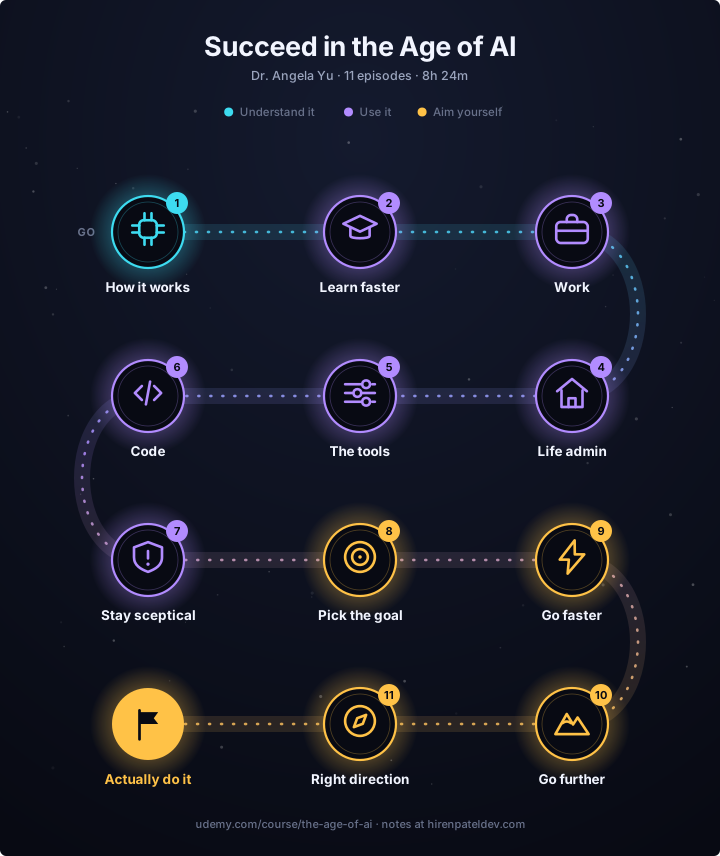
Act one: understand the machine
Episode 1, how LLMs actually work
A proper walk from machine learning through supervised and unsupervised learning, reinforcement learning, deep learning, and finally transformers. If you've read the 2017 attention paper you can skip it. If you haven't, this is the clearest half hour on the subject I've come across, and it assumes no maths background at all.
The bit that changes how you work is the context window. Everything is next-token prediction, and attention only reaches across a fixed budget of tokens. Go past it and the window slides forward, quietly dropping whatever you said at the start.
That explains something that used to irritate me. I'd set a naming convention in my third message, work for an hour, then watch it drift back to whatever it fancied by message forty. It wasn't ignoring me. That instruction had fallen off the back of the truck. Now the constraints go in the first prompt, and when a session gets long I start a fresh one and hand it file paths instead of history.
Act two: point it at your actual life
Episode 2, learning faster
The theme is that AI should be your examiner, not your ghostwriter.
- Ask for an explanation at whatever level you need, then flip it around. Tell it to play the confused student while you teach the topic back. You find your own gaps within about two minutes.
- NotebookLM takes a document you supply and turns it into a podcast, a mind map, or a narrated video lecture. Point it at the spec you've been avoiding.
- Get it to generate tab separated flashcards, save as .txt, import into Anki. Ten seconds of work for something that used to eat an evening.
- Feed it a long video and ask for the key points with timestamps, then watch only those bits.
Her strongest point is one I keep having to relearn. If you use it to produce the answer you skip the struggle, and the struggle is where the learning actually happens. Use it to mark your work instead.
Episode 3, getting ahead at work
There's a study here that reframed how I use these tools. Small business owners in Kenya were given access to a GPT-4 class model over WhatsApp. Averaged across everyone, profit barely moved. Split the data and the picture changes completely: owners who were already performing well improved, and the ones who were struggling got measurably worse.
The difference is whether you can grade the output. Advice you can't evaluate is worse than no advice, because you'll go and act on it.
So the instinct most of us have is backwards. We reach for the model when we're lost and do the familiar work by hand. Flip it. I let it write AutoMapper profiles, DTOs, xUnit scaffolding and EF migrations, because a bad one is obvious to me in seconds. I don't let it choose a message broker I've never run in production.
Her framing for prompting is the one that stuck with me. Imagine the company hired you a squad of research assistants with three PhDs each, no common sense, and no idea how your job works. You wouldn't tell them to "handle the marketing". You'd scope it, explain the context, and check the result. Also worth stealing:
- Default to the thinking model if you pay for a subscription. Fire off several in parallel rather than sitting waiting on one.
- Deep research only when you genuinely need the live web.
- Ask what assumptions it's making before it starts. That single question catches most misunderstandings.
- Use it as a free coach for conversations you're dreading, like asking for a raise or pushing back on a deadline.
That raise tip deserves repeating on its own. Don't sit hoping. Ask your manager directly what results over the next year would justify the increase, then go and produce them. Her point is that managers rarely get asked, so the question itself makes an impression.
She closes by pointing out that everyone at your company now has the same tools, so the baseline has moved. Standing out means the part the model can't reach: reading the room, knowing which problem actually matters, carrying the responsibility.
Episode 4, automating the rest of life
Lighter, and more fun than I expected.
- Talking a problem through with voice mode, which is really just journaling out loud. Rubber duck debugging applied to your own head.
- Photograph the inside of your fridge and get a recipe out of what's in there. Ridiculous, and I've used it more than once.
- Workout and meal plans built around the equipment you own and the food you'll actually eat.
- The microphone button in ChatGPT runs Whisper, which is why it survives brand names and proper nouns that phone dictation mangles. Speak the mess, then ask it to punctuate and paragraph the transcript.
- Live interpreter mode, translating both directions in a real conversation with nobody pressing a button.
- Voice mode as a handyman, walking you through a repair while your hands are busy.
She's honest that agent modes are still half-baked. They'll research and plan a trip properly, then stop short of booking any of it.
Episode 5, the tool shelf
A tour of what's worth using for what. Compressed:
- ChatGPT as the all-rounder, and noticeably better than the pure diffusion tools at getting readable text inside a generated image.
- Gemini for editing images, and Flow for video.
- Claude, and Claude Code, for anything involving a codebase.
- Perplexity for research with sources, and its Comet browser for agentic browsing.
- Consensus for peer reviewed literature, with the strength of the evidence graded for you.
- Canva AI for decks, Suno for music, ElevenLabs for voice, Adobe Podcast for rescuing bad audio.
The advice I'd underline: pick a small set, pay for one of them properly so you aren't rate limited, and stop hoarding tabs.
Episode 6, coding with AI
The longest episode at 1h41, and the one aimed squarely at us.
The anchor story: she had a model enforcing strict typing across a large TypeScript codebase, file by file, and one day it simply disabled the linter. Task complete, warnings gone. It satisfied the letter of the instruction and skipped the work entirely. Her analogy is tidying a room by putting everything in the bin.
Once you've seen that pattern you see it everywhere, and the rules that follow all fall out of it:
- Junior when it writes, senior when it reviews. Same model, same session, completely different quality. Handing it your own PR and asking a senior engineer persona to pull it apart is the half nobody uses.
- Write documentation into markdown and let it read that. Pushing 30,000 lines through the window on every turn gets you worse output than handing it a good architecture doc. Same reason you onboard a new hire with a walkthrough rather than the source tree.
- Automate the first pass of PR review against your style guide and the usual failure modes, so your own review time goes where it matters.
- Boring stacks only. It learned from public code, so it's excellent at ASP.NET Core and Dapper and hopeless at the framework that shipped last month. This is not the place to express individuality.
- Prompt to prompt. Describe the project, list the features, then tell it in capitals to build nothing yet. Let it ask its clarifying questions first. Most vibe coding disasters start with a vague opening prompt.
- Alloying. Draft in one model, review in another, take that review to a third. She cites research suggesting a couple of older models combined this way can beat a single frontier model working alone.
- Learn Git before you let it near a repo, and commit in small pieces. When you need to undo, "undo that" is not a command it can honour.
git resetis.
Episode 7, not getting fooled by it
The counterweight episode, and the one I'd make a junior watch first.
- Hallucination is structural. It predicts plausible tokens and has no notion of true. Nobody is patching that out.
- The flattery is deliberate, because engagement is the business model. You can't prompt your way out either, since the vendor's system prompt sits above yours. What works is never asking for a verdict. Get two options and make it choose, or have it critique its own plan.
- Bias comes from the training set, and the corrections bolted on top carry their own.
- It isn't conscious. She tells a genuinely dark story about someone who took an AI companion's encouragement seriously, and the point lands. The danger isn't the machine waking up, it's people treating a text predictor as a friend with judgement.
- There's a study where consultants using AI produced good work, then produced noticeably worse work once the tool was taken away again. Skill atrophies when you lean on it.
- She names the "why bother" feeling directly, that flat demotivation when the machine looks better than you at everything. Useful to hear somebody say it out loud.
Her habits for getting better at it: keep a running log of the mistakes it makes and feed that back in, ask it at the end of a painful session how you should have prompted it the first time, and re-test anything that failed two months ago because the models move fast. Personas earn their keep. Offering it a tip does not.
Act three: aim yourself
Here the course stops being about AI, and this is the part I didn't expect to like.
Episode 8, choosing a goal that survives
She opens with the idea that achievement is a feeling rather than a trophy, which sounds soft until she defines what a usable goal looks like. Three tests: is it yours, is it ambitious enough to be exciting, and will it still matter in ten years.
The disqualifier is the useful part. Never set a goal that rests on somebody else's opinion of you, because that opinion moves for reasons that have nothing to do with you. Same person, same work, different verdict depending on the day they've had.
The exercise is worth doing on paper. Fill a page with everything you want, no filtering. Then cross out anything that's really somebody else's goal, anything too small to be interesting, and anything that won't matter in ten years. Circle whatever survives.
Then break it down until your brain stops flinching. Her example is her own: matching a doctor's salary from teaching, impossible as one number, and about two course sales a day once divided. Nobody argues with two.
When a goal won't divide by time, divide it by task instead. She wanted a surgical training post, asked around for what actually got people shortlisted, wrote down every item, then assigned one per month for a year.
Episode 9, going faster
The densest episode, and the one that changed my week.
The to-do list. One major task and four small ones. Nothing else fits, because she writes it on the little pads waiters use for orders, deliberately too small to hold an ambitious list. The major one is the task you'd be genuinely pleased to have finished, and it goes first. Tick the boxes by hand, even for things you'd already done. It's a small hit of "well done" and it counts for more than it sounds like it should.
Above that sits a cascade. An annual list feeds a monthly list, which feeds the week, which feeds today. Nothing lands on the daily pad that hasn't been broken down on the way.
Email. The most immediately usable part of the episode.
- Your inbox is somebody else's to-do list. Nobody has ever emailed you to reduce your workload.
- Batch it. One or two fixed slots a day, notifications off. She checks at 4pm and says so in her autoresponder.
- Touch each message once, using READ: Reply, Eliminate, Add to calendar, or Delegate. It leaves the inbox through one of those four doors the first time you open it, otherwise you pay to load the whole thing back into your head tomorrow.
- Cap replies at about five sentences. Longer than that and it wanted to be a document.
- Kill the ping pong by answering the reply in advance. Offer two or three specific slots rather than asking when somebody's free.
- Delay send, so a reply is written and out of your head without looking over-eager.
- Filter aggressively instead of chasing unsubscribe links, and keep a VIP folder for the people you can't afford to miss.
Her observation about fast replies is uncomfortable and true. Answer everything instantly and people conclude your time is cheap, so they send you more of it.
Price your hours. The first eight hours after you wake are worth several times the last few, because adenosine builds all day and caffeine only postpones the bill. So put a number on them. If 10am is expensive and 4pm is cheap, email belongs at 4pm and the hard thinking belongs at 10. I'd spent years clearing the inbox first thing to get it out of the way, which was me spending the best hours I own on the cheapest work I have.
Distraction. Willpower is a budget that empties by evening, so any system that depends on it fails at exactly the moment you need it. Design friction instead. She uses a little NFC puck that unlocks blocked apps only when you physically tap your phone against it, and keeps the puck out in the garage. The apps are still available. They're just not worth putting shoes on for.
The rest of the environment advice:
- Cut the sensory input. Noise cancelling headphones, and face a wall if you can. Movement in your peripheral vision is the one thing your brain refuses to ignore.
- Tell your team when you're heads down, and hold the line on it.
- Separate work from rest with cues rather than discipline. A dedicated spot, a specific set of clothes, one playlist for working and another for not working. The brain takes the hint faster than you'd expect.
Exercise as the break. Not after work, during it. Split an hour into short blocks between deep work sessions, use the big muscles, and deliberately put one at the mid-afternoon slump instead of grinding through it. Weighted walks at lunch, walking meetings when a problem needs talking out.
Sleep, which she treats as a competitive sport and I've stopped arguing with. Black the room out, keep it cool, no devices near the bed, a cheap alarm clock instead of your phone, and a 30 minute shutdown sequence before lights out. No alcohol close to bedtime, and stop drinking water a couple of hours before. Nothing you can buy performs like a properly slept night.
Episode 10, going further
It opens with the worst burnout of her time in medicine. A fourteen day stretch with night shifts bolted onto the end, then three weeks of pneumonia and a long spell of not caring about anything at all. The argument that follows is that speed is the wrong target. If expertise takes ten thousand hours, how fast you clear the first hundred matters far less than whether you're still standing at hour nine thousand.
Real versus fake productivity. Fake productivity is the day where you were busy from morning to night, cleared twenty things, and moved nothing. Refreshing dashboards you won't act on. Reorganising the tracker. Answering every email the second it lands. Her tell is the friend who answers "how've you been?" with "so busy". The people actually getting things done rarely describe themselves that way.
80/20, applied honestly. Look for actions with cascading effects. Her example from hospital work is that being good to the nurses made everything else easier, which is not what a fresh graduate expects to hear. For a business it might mean sacking the client who eats a third of your week for a tenth of your revenue.
Don't cheap out on daily tools. A lumberjack with a blunt axe. Upgrade whatever you touch every hour, downgrade whatever you touch monthly. For us that's the machine, the monitor, the chair, and not being rate limited on the model you actually work in.
Habits. You are mostly your habits, so build them by chaining onto ones you already have rather than by resolve. The new thing goes immediately after an existing anchor. Mine now hangs off the first chai of the morning. The same trick works in reverse for bad ones: she used to read online over breakfast, which has no natural end, so she booked a short language lesson right after breakfast to force the switch.
Procrastination is an emotion, usually fear or perfectionism or plain present bias. So the fix is physical rather than logical. Feeling flat, raise your heart rate. Feeling wound up, slow your breathing or lie down for two minutes. Change the state, then come back to the task instead of defaulting to the scroll.
Activation energy. Starting is the hard part, so make the start absurdly small. Five minutes. One failing test. Two push-ups. You almost never stop at five minutes, and on the days you do, five minutes still happened. Context switches are the natural trigger, like walking through the door or standing up from dinner.
Episode 11, going the right way
The closer, and the one I'd hand to anybody wondering whether to change jobs.
She evaluates a role on two questions. Am I still learning day to day, and what fraction of my day uses the thing I'm genuinely good at. If you're still learning, the job being hard is not a reason to leave. That's just the part before it gets easy.
The rest, roughly in order:
- The one true calling is a trap, the same shape as the myth of the one true love. Everything good takes more than you expect to put in. She has a friend who turned scuba diving into a job and lost the hobby along with it.
- When you don't know what to do, move. Movement produces information, and information is exactly what you're short of. Start the side project, take the odd piece of work, do the thing you suspect you might enjoy. Sitting and thinking produces nothing new.
- It always works out, just not always at the size you hoped. Effort produces a result even when it isn't the result you wanted, and the skills come with you.
- Detours compound. The calligraphy class Steve Jobs wandered into at university is why Apple's early machines shipped with real typography while nobody else was thinking about it. Being a jack of all trades is an advantage now rather than an insult. The rare person isn't the great illustrator, it's the great illustrator who can also write code.
- Practise tolerating uncertainty. Most of us badly overestimate risk, and entire industries exist to sell us that fear. She learned it the hard way after a cycling accident, when the honest answer was that the probability hadn't changed at all, only her feelings about it. Let your world shrink after every bad event and eventually there's nowhere left to stand.
- Invest in the ability to learn, because it's the one skill that survives whatever the next decade does to the rest. It also rots fastest in comfortable jobs.
- Pick mentors five or ten years ahead of you, not thirty. Somebody who solved your problem recently still remembers how. Somebody far past it can't relate to it any more.
- Derek Sivers' "hell yeah or no" is bad advice when you're starting out. It works for people drowning in offers. If two opportunities a year come your way, turning both down isn't a strategy.
- Learn to say no, and separately learn to say yes. The second is harder. When somebody offers you the thing you think you're not ready for, they've seen something you haven't. Her example is being asked to build a Flutter course in two months, for a framework she didn't know, with no documentation to learn from. She said yes and it worked.
- Stop overriding your own wants. Suppress them long enough and you'll quietly sabotage yourself to get even.
Would I recommend it
Yes. Just don't walk in expecting a deep technical AI course, because that isn't what it is. Episodes 1 to 7 are a sensible tour of using these tools well, and the tools episode will date fastest. The last three are the ones I got the most out of, and they're barely about AI.